|
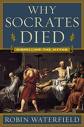
Why Socrates
Died (2009): UK hardback; UK paperback
Why Socrates
Died: US hardback; US
paperback
Why Socrates
Died: Canada hardback; Canada paperback
ebook
version
Greek
edition
Socrates' trial and
death together form an iconic moment in Western civilization. The picture we have
of it - created by his immediate followers and perpetuated in countless works of
literature and art ever since - is that a noble man was put to death in a fit of
folly by the ancient Athenian democracy. But an icon, an image, is not reality. The
trial was, in part, a response to troubled times - a catastrophic war and turbulent
social changes - and so provides a good lens through which to explore the history
of the period; the historical facts allow us to strip away some of the veneer that
has for so long denied us glimpses of the real Socrates. Written by a scholar, but
not only for scholars, this is an accessible, authoritative account of one of the
defining periods of Western civilization.
Reviews
‘
Clarity, confident arguing, good sense ... The
cleverness of Waterfield’s richly told and enjoyable book is that he uses the death
of Socrates as a way of introducing a wonderfully full picture of Athens in the
fifth century ... As clear an exegesis of the Peloponnesian War as the general
reader will find ... Waterfield builds up a cogent
picture’ - Charlotte
Higgins, Guardian
‘Waterfield is an
accomplished guide ... we get a vivid account of the vested interests of the day
... absolutely secure in his material, Waterfield can stride off on thematic
digressions such as the nature and point of law ... [he] is sympathetic and
skilful. His physical delight in Greece resonates. He is sharp with words, robust
in his knowledge of antiquity, and honest. Socrates - who encouraged men to reason
and question, to “dispel'” - would have approved’ - Bettany
Hughes, The
Times
‘Robin Waterfield’s erudite but deeply engaging book takes
a historian’s scalpel to the myths. Richly detailed, briskly written, it fills in
the bloodstained background of Athens around 400 BC: the enervating wars with
Sparta, the brutal regime of the “Thirty Tyrants”, the fatal political charisma of
Socrates’ ex-lover and pupil, Alcibiades. Even if your vote would still have let
the sceptic dodge the poison, you grasp the purpose of the prosecution case.
History defeats hindsight’ - Boyd Tonkin, Independent
‘Incisive and readable
… Waterfield certainly managed to keep my interest, and even provide me with some
new insights, and he will certainly do the same for the majority of readers …
Waterfield paints for us in a manner both learned and lively’ - John
Dillon, Irish
Times
‘Lucid, careful and
balanced ... an admirably detailed and nuanced account of the context of the trial
and the range of factors in play in its outcome’ - Michael
Trapp, Anglo-Hellenic
Review
‘Waterfield ... offers
an informed and well-written account of classical Athenian history ... readable and
interesting ... he describes well the ambitious and unscrupulous characters that
dominated the public life of the age’ - Barbara
Graziosi, Times Higher Education
Supplement
'Engaging, informative
and beautifully written ... It presents a serious and thought-provoking challenge
to anyone who believes that we can understand why Socrates was tried and executed
merely by reading the apologies of Plato and Xenophon' - Thomas C.
Brickhouse, Polis
‘Waterfield’s narrative brings 399 BCE to life, giving us a
genuine sense of how it felt to live through the social unrest and panic that
swept Socrates into the abyss ... essential reading for everyone interested
in Socrates and his time ... Why Socrates Died presents a theory about Socrates’ trial that many
people will find appealing because of its sensitivity to the trial’s place
and time. And it does this while resolving some of the most serious problems
with similar views ... Waterfield has updated the case for a political motive
behind Socrates’ trial, and he has given us some very good reasons to
consider it. His book points us in a new direction, and it is a promising
one: we should focus primarily on reconstructing the political culture of
Socrates’ trial, not Socrates’ irrecoverable beliefs, which, after all,
probably were not known or understood by anyone on his jury, and may not have
been reported by Xenophon or Plato. It
is now up to others to find out whether this new path will bear fruit. Let
the next round of debates begin!’ – Mark
Ralkowski, Ancient
Philosophy
‘Admirably clear and
informative ... shows enviable mastery of the ancient sources’ – C.C.W.
Taylor, Phronesis
‘Thorough and
fair-minded’ - Peter Jones, Literary
Review
‘Enormously useful’ – William M.
Calder III, Classical Journal
‘[A] lively revision of
the evidence’ - Frederic Raphael, truthdig
‘Remarkable and
thoroughly original’ - Kevin Hartnett, Christian Science Monitor
‘Masterfully drawing
the strands of his narrative together into an analysis of the trial itself,
Waterfield recasts Socrates as, not martyr, but necessary sacrifice to the new
state' - Observer
‘A clear-headed
portrait of Athenian history and culture that will engage all interested readers’ -
Jonathan Gibbs, Financial
Times
‘Makes his case
compellingly’ - Jenny Bunker, New
Humanist
‘[Waterfield is] less
interested in rewriting history, though, than re-reading it, teasing out the
complex and competing strands of ancient commentary to uncover the agendas - of
Socrates himself, of his accusers and friends. He’s also concerned to comprehend
the crime, to understand the mindset which could convict the great man as an enemy
of the people. It sounds impossibly rarified - and you have to admire the
scholarship and subtlety - yet this is an absorbing book. After the red meat of
Roman history, that of ancient Athens can easily feel anaemic - a bit too
classically perfect, too sedate. Here, on the other hand, we get a strong sense of
just how down and dirty the democratic way was and just how brutishly the popular
voice could roar.’ Michael Kerrigan, The Scotsman
‘Sitting atop a solid
foundation of scholarship, this valuable survey of an important period of ancient
history is especially useful ... Of the many introductory studies on the Athenian
judicial system, the trial of Socrates, the conflict between Athens and Sparta and
the reasons that democracy gave way to oligarchy in Athens, this is among the
clearest, most well-organized and most concise’
- Publisher’s
Weekly
‘Robin Waterfield takes
a fresh direction in Socratic research, revealing the how and why of the decision
of the new democrats to offer the old man the hemlock that sent him to sleep
forever’ - Alasdair Buchan, Diplomat magazine
‘Waterfield tells his
story well’ - Mark Golden, Globe
& Mail (Canada)
‘[A] fine book written
primarily for the general reader … a solid account of Greek history … makes a good
case’ - Mark Joyal, Winnipeg Free
Press
'Highly recommended' -
J.R. Asher, Choice: Current Reviews
for Academic Libraries
'Impressive scholarship
redefining an iconic event' - Bryce Christensen, Booklist
'Fascinating ...
belongs in all libraries' - Steward Desmond, Library Journal
‘Surprisingly
entertaining’ - Tod Hoffman, Montreal
Gazette
‘Intriguing and
enlightening … brings the ancient world to life … fascinating and page-turning
history … wonderful’ - Wayne Hurlbert, Blog Business
World
‘A clear, precisely
informed portrait of the times and tensions’ - Allan Graubard, Leonardo Reviews
online
Rights
Sold
UK: Faber and
Faber
US:
Norton
Canada: McClelland and
Stewart
Greece:
Psichogios
Spain:
Gredos
|